The General Purpose AI (GPAI) Code of Practice is the European Union’s voluntary code accompanying its Artificial Intelligence Act. Its aim is to give guidance to providers of AI services to whom the new rules apply, to flesh out instructions that were kept short in the actual act itself, and to serve as a framework to work towards compliance. So what is in there, how did the industry react, and what role will it play going forward?
Originally planned for release in April, the code of practice is now (July) available¹, just in time for the next stage of the EU AI Act coming into force on the 2nd of August 2025 ².
Drawn up by experts organized into four working groups³ under supervision of the newly established EU AI Office, the code is organized into three chapters:
The code is voluntary and not officially part of the EU AI Act. While signatories of the code are not legally bound by it, adherence to the code will certainly play a part in determining potential fines in case of non-compliance with the AI Act’s obligations for GPAI providers.⁴
The chapter on Transparency is the most formal one; it lays out the transparency requirements for GPAI providers under EU AI Act Article 53(1), points (a) and (b). It provides a convenient form to be submitted to the regulator. Most of the requirements are of a purely technical nature, such as training material size, type of training material, model output formats, etc.
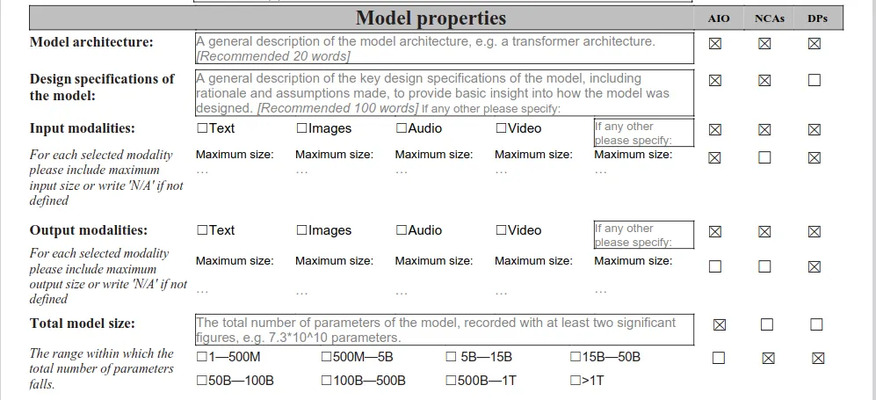 Excerpt from the example transparency form provided in the code
It also stipulates high-level descriptions of the training process, methods of data curation used and methods to detect and exclude certain datasets.
Counter-intuitively, the chapter on copyright does not lay out specific laws and regulations touched by harvesting training data and potential copyright infringement of the generated output. Rather, it is a general commitment to respect and take into account the copyright laws of the EU member states and mitigate the risk of copyright infringement for users of the model.
Most importantly, the code stipulates putting in place a mechanism for copyright holders to file complaints:
[..] Signatories commit to put a mechanism in place to allow affected rights holders and their authorised representatives, including collective management organisations, to submit, by electronic means, sufficiently precise and adequately substantiated complaints concerning the non compliance of Signatories [..](Chapter “Copyright”, page 6)
This seems like a reasonable mechanism and puts at least some pressure on GPAI model providers to be accessible in case of obvious copyright infringement.
The chapter on Safety and Security is certainly the most challenging one: It describes a state-of-the-art approach to managing risk and structuring the model release cycle.
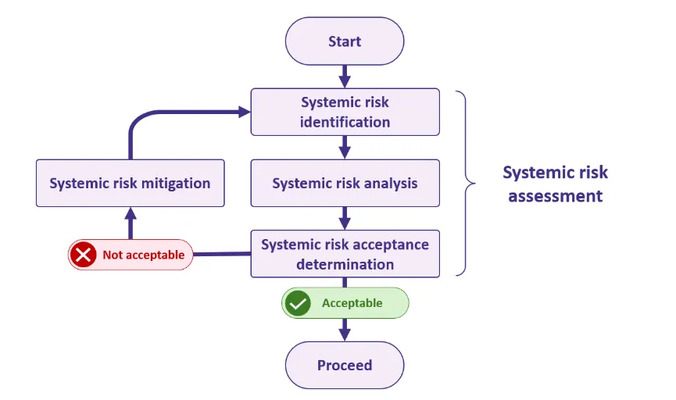
Full systemic risk assessment and mitigation process (Source: AI Code of Practice, Chapter 3, p9)
While the first part of the guideline deals with risk-management in advance of making the model available for the public, the second half deals with monitoring, incident reporting and retention of documentation.
Signatories will keep documentation of all relevant information gathered in adhering to this Commitment for at least five years from the date of the documentation or the date of the serious incident, whichever is later, without prejudice to Union law applicable to such information. (Chapter “Safety”, Measure 9.4)
The chapter has a strong focus on accountability, both in advance and after GPAI models have been made public and moved into production. The requirement to maintain and retain relevant documentation about steps taken, incidents and mitigations will certainly play a part when it comes to questions of liability.
Despite a lot of pushback against the EU AI Act, especially from the US and the UK [], the European Union has said it will stick to the EU Act’s timeline. This means that putting compliance mechanisms into place should be a priority for those GPAI providers that are planning to roll out new models in Europe.
With regard to the Code of Practice, Meta is the only larger AI company so far that has publicly indicated an outright refusal to sign the Code of Practice,⁶ while Microsoft indicated it likely would. It will be interesting to watch which companies will use the Code of Practice to distinguish themselves from the competition and which companies will continue to lobby against it. Meanwhile, it is hard to see how companies like xAI will deal with the requirements laid out in both the Code of Practice and the EU AI Act itself.
The recently released US “AI Action Plan” indicates that the US government will continue to put (economic) pressure on the EU on behalf of the American AI industry to relax requirements or scrap them altogether. Considering the scope of the AI Act and the importance of the EU market for those companies, compliance requirements will be hard to ignore as long as the EU defends its regulation.
¹ The General-Purpose AI Code of Practice — European Commission
³ Meet the Chairs leading the development of the first General-Purpose AI Code of Practice — European Commission
⁴ Article 53: Obligations for Providers of General-Purpose AI Models — EU AI Act
⁵ EU says it will continue rolling out AI legislation on schedule, Techcrunch , 4 July 2025
⁶ Microsoft likely to sign EU AI code of practice, Meta rebuffs guidelines — Reuters, 18 July 2025
Title Image by Wolfgang Hauptfleisch (with help of MS image designer)